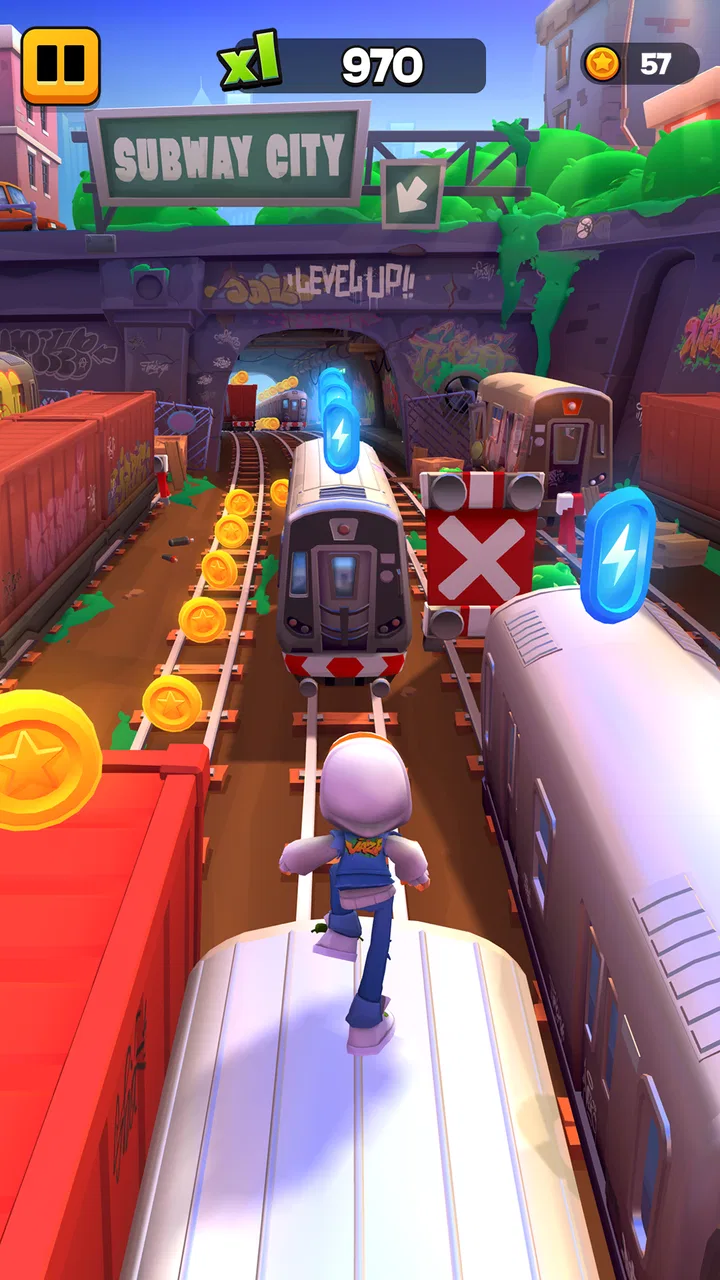
Subway Surfers City
- 4.6
- Rating
- 10.00M
- Installs
- Free
- Price

 Analysis by App-foxy
I found Subway Surfers City easiest to understand after a few minutes with my thumbs on the screen: the character is always moving, and my job is to react before the next barrier, gap, or change of lane arrives. It is a free action game from SYBO Games, built around quick decisions rather than long explanations. The familiar Subway Surfers identity is still visible, but this entry focuses my attention on the immediate run, the hoverboard, and the feeling that one more attempt might be enough to improve what just went wrong.
That “one more attempt” feeling is the important part. A run begins quickly, the controls answer almost immediately, a mistake ends the current effort, and the restart is close enough that failure rarely feels like a serious interruption. I can play when I have only a short break, but there is also enough room for a more deliberate session when I want to chase a cleaner route. My overall impression is positive, although the game is much better suited to players who enjoy repetition and reflex practice than to anyone looking for a deep story or a slow, exploratory adventure.
How the first action turns into a playable routine
The opening seconds do most of the teaching. I do not need to study a complicated interface before moving; I can concentrate on steering, jumping, dodging, and using the hoverboard while the environment approaches. That direct start is one of the game’s strongest choices. It makes the experience approachable for younger players and for anyone who has not touched an endless runner recently, while still leaving plenty of room to improve through timing.
You May Also Like

 Blood Strike: 2.5 Anniversary
Blood Strike’s Loadouts Turn Every Drop Into a Tactical Gamble
A close look at Blood Strike’s custom loadouts: how fast access to signature weapons reshapes its battle royale rhythm, rewards preparation, and narrows the gap between fights.

 Pandora - Music & Podcasts
Pandora’s Music Is Easy to Start, but Harder to Recover
Pandora’s strength is its low-effort path from a seed to a station. Its weak spot is how much confidence it asks you to place in connection, setup, and quiet recovery.

 8 Ball Pool
 Is Built on Rivalries, Rematches, and Routine
A close look at the rivalries, rematches, shared routines, and unanswered safety questions that turn a quick pool match into a persistent mobile community.

 Samsung Music
’s Quiet Strength Is Playing What You Already Own
Its reach comes less from spectacle than from dependable access to a personal library. That simplicity is both the app’s strongest retention engine and its ceiling.

 AccuWeather: Weather Radar
AccuWeather Review: A Quick, Clear Forecast for Everyday Decisions
For everyday plans, the best forecast is the one you can understand quickly. AccuWeather makes rain timing, radar, and local conditions easy to act on, with a few trade-offs.

 Hill Climb Racing
Why Hill Climb Racing Still Turns Crashes Into One More Run
A tiny car, a bumpy hill and one more upgrade: Hill Climb Racing keeps resurfacing because its simple chaos makes every near-miss feel personal.
More From Our News Desk



What makes the first action satisfying is the clear relationship between input and movement. A swipe is not an abstract command hidden behind menus; it is a decision made under pressure. I see an obstacle, choose whether to change lanes or jump, and immediately learn whether my timing was good enough. The game’s action category is therefore accurate in a practical sense: the challenge comes from reading the path and reacting, not from managing a large collection of buttons.
The hoverboard adds another layer to that first decision. I do not treat it as decoration because activating it changes how I think about risk. When the path becomes uncomfortable, the board can feel like a chance to protect a promising run, but using it carelessly can also make me less disciplined about learning the route. My useful habit was to reserve it for moments when it could preserve progress rather than triggering it automatically at the first sign of danger.
For a realistic everyday example, I can imagine opening the game while waiting for a coffee or sitting on public transport. A short run gives me something active to do without requiring a long setup. If I make a mistake, I can put the phone away immediately; if the run is going well, I can continue for another attempt. That flexibility is more valuable than it sounds because the game does not demand that every play session become a major commitment.
The controls are simple, but simple does not mean effortless. The screen can become visually busy when several possible reactions arrive close together, and a player who swipes too early may blame the control system before recognizing that the timing was the real problem. I found that keeping my eyes farther ahead, rather than staring only at the character, made the next move easier to read. That is a small adjustment, but it changes the experience from frantic guessing to planned reaction.
The feedback rhythm is built from tiny decisions
Once the run is moving, the game settles into a repeating rhythm: observe, choose, act, and immediately check the result. A successful dodge gives me a brief sense of control, while a clean jump makes the next obstacle feel manageable instead of threatening. The feedback is not complicated, but it is constant. Every safe movement confirms a habit, and every collision points toward a specific moment that I could handle differently next time.
This is where the game earns its replay value. I am not restarting simply because the screen tells me to; I am restarting because I usually understand why the previous run ended. Maybe I committed to a lane too soon, reacted to the nearest obstacle instead of the next one, or treated the hoverboard as a panic button. Those small explanations make failure useful. A run can be brief and still provide a lesson.
I also like that the action does not require me to remember a large rulebook. The mental workload comes from attention and timing. That makes the game a good fit for players who want a reflex challenge they can learn through repetition. It is less appealing if I want strategic planning that continues between sessions, because the most important decisions happen in real time and disappear when the run ends.
My most effective approach was to divide the screen into priorities. First I looked for the safest immediate route, then I checked what was coming behind it, and only after that did I worry about collecting anything optional. This matters because chasing every attractive target can pull attention away from survival. In an endless runner, a slightly less rewarding route that keeps the run alive is often better than a tempting line that forces a rushed movement.
That trade-off gives the action more texture than the basic controls suggest. I am constantly choosing between a comfortable path and a riskier one that may offer a better result. The game does not need lengthy explanations to create tension; the path itself supplies the question. Do I take the safe lane and preserve the attempt, or do I make a sharper move because the reward might justify the danger?
Where the reward becomes meaningful
The reward structure works best when I connect it to improvement. Finishing a longer run, handling a difficult sequence, or using the hoverboard at the right moment feels worthwhile because I know the result came from better decisions. The game’s free entry also makes it easy to try without a financial commitment, which is helpful when I am deciding whether this style of action suits me.
There are in-app purchases ranging from $0.99 to $99.99 per item, so I would not describe the experience as completely separate from spending. That range is important for parents and for players who prefer a tightly controlled budget. I can begin without paying, but I would still approach optional purchases carefully and decide in advance whether I want the game to remain a no-cost pastime.
For me, the best reward is not simply reaching a larger result. It is noticing that a section that once caused repeated collisions has become familiar. That kind of progress is personal and easy to feel, even when the game does not turn every improvement into a dramatic event. Players who enjoy mastering patterns will probably get more from this than players who need a constant stream of new mechanics to stay interested.
The game’s popularity also gives a useful signal about its accessibility. It carries an average rating of 4.8 from around 179 thousand ratings, with more than 10 million installs. I would not treat those figures as proof that everyone will enjoy it, but they do match my impression that the basic concept is easy to pick up. The audience appears broad, while the actual satisfaction still depends on whether repeated runs feel motivating or repetitive to the individual player.
The age rating is Everyone 10+, which feels appropriate for a fast, obstacle-focused game that is easy to understand but still asks for concentration. I would be comfortable describing it to a family as approachable, while still reminding parents that the presence of in-app purchases deserves attention. The game can be enjoyed as a quick reflex activity, but purchase controls are sensible if a child will be playing on a shared device.
Why the reset keeps another session alive
The reset is central to the design. When a run ends, I am not forced to reconstruct a complicated setup or wait through a long preparation phase. The short distance between failure and another attempt keeps the emotional cost low. I can be annoyed by a mistake, but I am rarely discouraged from trying again because the next opportunity feels close.
This is a clever balance between pressure and convenience. The run matters while it is happening because one poor movement can end it, yet the overall game remains forgiving because restarting is so natural. That combination is why I can play for a few minutes without feeling that a failed attempt wasted my time. The reset turns mistakes into a prompt rather than a punishment.
There is a limit, though. If I am not in the mood to repeat a section or chase a better result, the same reset that feels convenient can begin to feel circular. The game’s core loop does not disguise what it is asking from me: repeat the action, refine the timing, and try to last longer. I would skip it if I wanted a campaign with a clear ending, extensive character development, or a world that rewards slow inspection.
Compared with a traditional platform game, this feels less like solving a fixed level and more like maintaining concentration through an ongoing stream of decisions. Compared with a slower action game, it offers less room to pause and plan. Its advantage over those alternatives is immediacy. I can understand my mistake within seconds and attempt a correction almost at once. Its disadvantage is that players who prefer exploration, puzzle solving, or carefully prepared attacks may find the constant forward motion restrictive.
The current version is 2.0.3, and the game runs on Android 8.0 or later. That makes the compatibility requirement worth checking before installing, particularly on an older phone. On a suitable device, I would still pay attention to comfort: rapid swiping can become tiring during longer sessions, and a smaller screen may make visual reading more demanding than a larger one. Those are not reasons to reject the game, but they affect how enjoyable repeated play will be.
Small habits that improve the experience
My first practical tip is to treat every failed run as a short review rather than instantly blaming luck. I ask myself which decision actually ended the attempt. If the answer is unclear, I focus on looking farther ahead during the next run. This simple habit makes the action feel less random and helps me improve without needing a separate training mode.
Second, I avoid spending attention on optional targets when the route is already demanding. A collection opportunity is only useful if I can reach it without losing control. The strongest runs often come from choosing consistency first. Once a difficult sequence feels familiar, I can experiment with a riskier line and decide whether the extra reward is worth the chance of a reset.
Third, I use the hoverboard with a purpose. Activating it whenever I feel nervous prevents me from learning which movements are genuinely safe. Waiting until it can protect a valuable run makes the item feel like a decision instead of a reflex. This is especially helpful for new players who might otherwise use every available safety option immediately and then struggle when it is unavailable.
Finally, I match the session length to my attention. Short attempts are ideal when I am distracted, but a longer session works better when I can keep my eyes on the path and accept a few failures. If I notice that I am swiping automatically or reacting late, I stop rather than forcing another attempt. The reset is quick, but that does not mean every restart is worthwhile.
Who should play it, and who should look elsewhere
I would recommend this game to someone who wants a free action title with instant movement, clear goals during each run, and a satisfying cycle of reaction followed by retry. It is particularly suitable for short breaks, casual competition with personal bests, and players who enjoy improving through repetition. The straightforward controls also make it easier to share with someone who does not normally play complex mobile games.
I would be more cautious about recommending it to a player who dislikes endless-runner structure. The game does not transform into a story-driven adventure simply because the setting is lively. Its heart remains the run: move, dodge, survive, make a mistake, and begin again. Anyone seeking a carefully paced campaign, deep equipment management, or a strong narrative should choose a different kind of mobile game.
Parents should also consider the purchase range before handing over a device. The game is free to start, but optional items can cost from less than a dollar to nearly a hundred dollars. I would set a clear rule about spending and use the device’s purchase protections. That advice is not a criticism of the action itself; it is simply part of deciding whether the game fits a particular household.
My verdict on the complete loop
Subway Surfers City succeeds because its loop is easy to enter and hard to perfect. The first action is immediate, the feedback is readable, the reward comes from surviving and improving, and the reset removes most of the friction from trying again. I can feel the reason for another session without needing a long explanation: I was close to handling that sequence, and now I know what to change.
SYBO Games has kept the focus on accessible, quick-moving action rather than overloading the experience with systems that would slow down the first play. That clarity is a strength, but it also defines the game’s limits. I will not find the same depth I would expect from a larger platform adventure or a strategic action title. What I do get is a polished-feeling routine for testing my reactions in small, repeatable bursts.
For my own use, it works best as a pick-up-and-play game rather than an all-day commitment. I can open it during an ordinary pause, complete a few runs, learn from a failed movement, and stop without feeling unfinished. If that kind of compact challenge sounds appealing, the free download makes it easy to try. If repeated resets sound tiring rather than motivating, the bright presentation will not change the underlying structure.
My final recommendation is therefore clear but qualified: try it if you want fast hoverboard action and enjoy turning mistakes into better timing. Keep spending optional, protect your attention during difficult sections, and judge the game by whether each restart feels like a useful chance rather than a chore. For the right player, that is a strong loop—and the reason this runner can remain enjoyable long after the first swipe.
FAQs for Subway Surfers City
01What is Subway Surfers City and how does it differ from the original Subway Surfers?
Subway Surfers City is a dynamic spinoff of the classic Subway Surfers game, offering new cities and environments to explore. Players can enjoy unique city-themed challenges and collectibles. While maintaining the core gameplay of dodging trains and collecting coins, it introduces city-specific power-ups and characters, enhancing the original experience.
02Are there any in-app purchases in Subway Surfers City?
Yes, Subway Surfers City offers various in-app purchases. Players can buy coins, keys, and special packs to enhance their gameplay. These purchases can help unlock characters, outfits, and power-ups faster, although the game can be played and enjoyed fully without spending money, as it offers plenty of opportunities to earn rewards through gameplay.
03What are the system requirements for Subway Surfers City on Android and iOS?
Subway Surfers City requires Android version 4.4 or higher and iOS version 9.0 or later. It is designed to run smoothly on most modern devices, but optimal performance is achieved on newer models. The game requires an active internet connection for updates and leaderboard features but can be played offline for the core gameplay.
04How does Subway Surfers City handle data privacy and permissions?
Subway Surfers City prioritizes user privacy by adhering to strict data protection policies. The app requests permissions for internet access, necessary for gameplay updates and social features. It may also require access to storage for saving game progress. The developers ensure compliance with GDPR and other regional data protection laws to safeguard user information.
05Is Subway Surfers City suitable for children?
Subway Surfers City is designed to be family-friendly and is suitable for children. It has vibrant graphics, simple controls, and non-violent gameplay. However, parents should be aware of in-app purchases and advertisements. The game includes options for parental controls to limit spending and manage access to certain features, ensuring a safe and enjoyable experience for younger players.
Pros
- Engaging endless runner gameplay.
- Vibrant and colorful graphics.
- Frequent updates with new cities.
- Easy to learn
- hard to master.
- Fun missions and challenges.
Cons
- Can become repetitive over time.
- In-app purchases can be pricey.
- Requires constant internet connection.
- Ads can be intrusive at times.
- Limited character customization.

Subway Surfers City
Gallery